In 2026, the celebrations of the International Women’s Day and the World Water Day are closely aligning, with the latter dedicated to “Water and Gender Equality – Where water flows, equality grows,” and calling for a transformative, rights-based approach that places women's leadership at the centre of water solutions.
However, this year’s celebrations have a dark shadow cast over them, especially in the Middle East and North Africa (MENA) region. Further to the lingering political and socio-economic turmoil across the region, with armed conflict in Gaza and the escalation of hostilities in the region, water is constantly under fire.
Ensuring access to water, a fundamental human right, is imperative even in the midst of armed conflict. While International Humanitarian Law provides a solid basis for its protection during the conduct of hostilities, water is rarely spared from the ravages of combat and often weaponised. The result is that people’s livelihoods are severely compromised and health is threatened. And this is happening in a region already challenged by multiple interrelated pressures that are expected to become more severe by the triple planetary crisis (climate change, pollution and biodiversity degradation).
At this critical crossroads and transformation for the MENA region, and in the absence of political horizons, the conflict parties, including displaced constituencies, and supported by the international community, need to negotiate and create opportunities for dialogue and trust building. Water can be used by relevant actors as a tool for promoting such negotiations. In such environments, negotiations require more than technical expertise: they require structure, strategy, and the ability to operate effectively under pressure.
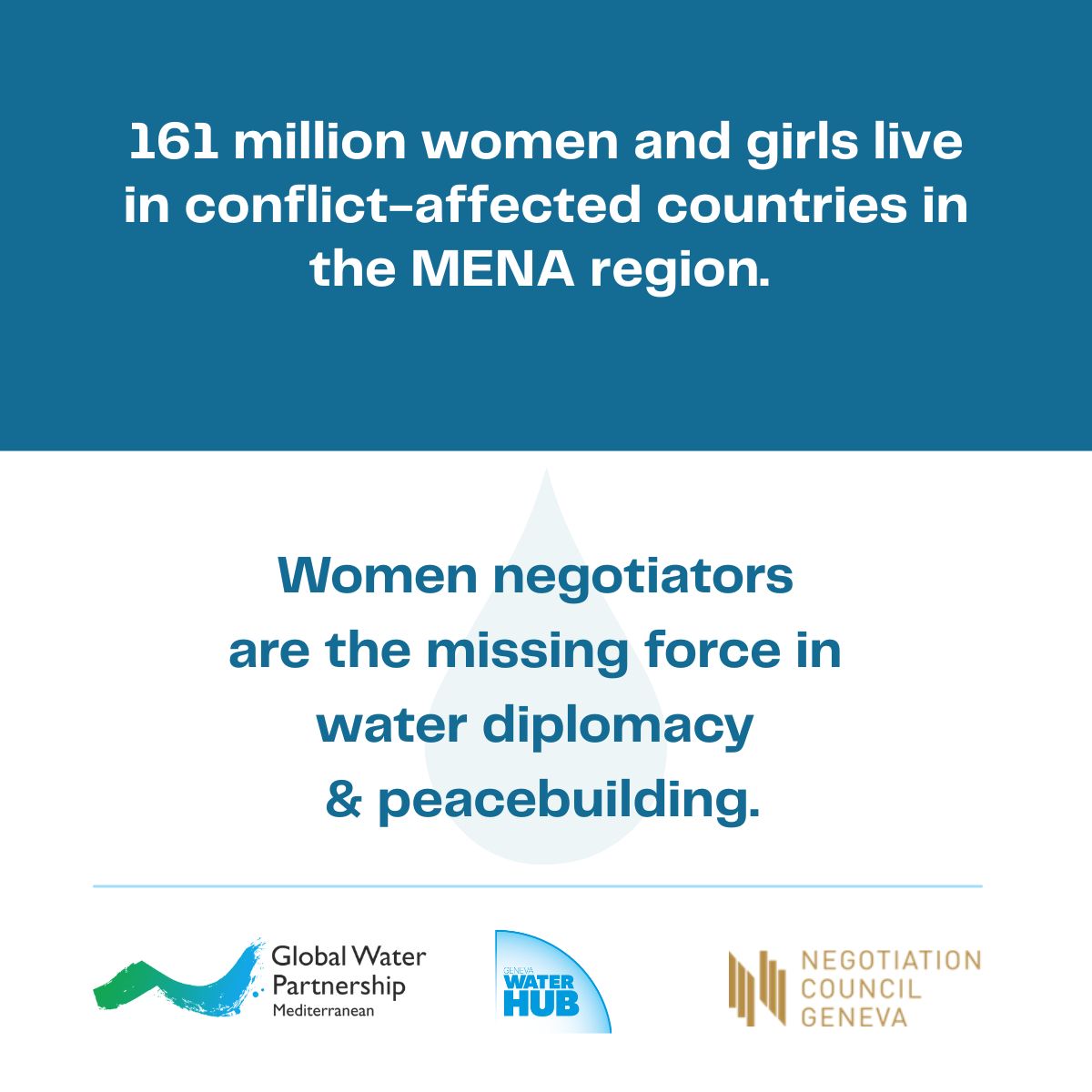
Women must be at the heart of such efforts and at the forefront of local and national response strategies. Unfortunately, the participation of women in key political processes is gravely overlooked in intra- and inter-state dialogue, negotiations and decision-making, albeit the fact that according to recent (March 2026) data, more than 161 million women and girls live in countries of the region affected by armed conflicts.[1] This gap is not only a matter of representation: it is a missed opportunity for more effective negotiation outcomes.
Strengthening the skills of the 21st century female water diplomats is crucial for having more women in leadership and decision-making positions in water diplomacy and transboundary water cooperation settings. This was the view of the almost 100 women water experts from Egypt, Jordan, Lebanon, Morocco and Palestine, who contributed to the elaboration of a Comparative Study on Empowering Women in Water Diplomacy in the MENA region[2]. This Study, the outcome of the ongoing collaboration between the Global Water Partnership – Mediterranean (GWP-Med) and the Geneva Water Hub (GWH), has given rise to an Initiative on Empowering Women in Water Diplomacy in the MENA region, calling for action to tangibly support female water leadership in the region.
Empowering women as negotiators – capable of operating under pressure, managing deadlocks, and navigating complex stakeholder environments – is essential for advancing both water governance and conflict resolution. The Schranner Concept® offers a particularly relevant framework for these contexts, as it teaches negotiators to embrace conflict, adopt a strategic mindset, and lead the process proactively through well-defined phases: Preparation, Opening, Leadership, and Deadlock. Building on this approach, the Negotiation Council Geneva[3] applies its expertise in high-stakes negotiations across the MENA region, combining targeted capacity-building with a strong emphasis on empowering women not only to participate, but to lead negotiations – thus, contributing to more inclusive and effective outcomes in complex, conflict-affected settings.
Recognising:
- the need to empower and invest in women, not only during times of peace and relative normality but also in situations of conflict and war, which are becoming more of the norm;
- the need to address water in conflict and fragile contexts as well as in stable ones;
- that water diplomacy is, at its core, a continuous negotiation process;
- the particular pertinence of the above to the MENA context, and especially at present;
The Initiative on Empowering Women in Water Diplomacy in the MENA region, while pursuing action on multiple tracks, is partnering with the Negotiation Council Geneva to build the negotiation skills of women of the region for water diplomacy and peacebuilding, as well as for efforts towards reconciliation and re-construction.
The partnership is timely and reinforces the shared commitment to:
- Advancing the peaceful resolution of conflicts- through negotiations and diplomacy
- Promote the understanding of International law
- Building capacity of women in water leadership, especially in conflict zones
- Strengthening women’s capacity not only to participate in, but to lead complex negotiations in water diplomacy
For further information please contact Dr. Anthi Brouma, Deputy Regional Coordinator, GWP-Med (anthi@gwpmed.org) or Ms. Natasha Carmi, Water-Peace Programme Manager for WANA, Geneva Water Hub (ncarmi@genevawaterhub.org), or Dr. Marzia Marastoni, Director, Negotiation Council Geneva (marzia.marastoni@schranner.com)
[1] Data from UN World Population Prospects. Countries included in the regional estimate are Bahrain, Cyprus, Iran, Iraq, Israel, Jordan, Kuwait, Lebanon, Oman, Qatar, Saudi Arabia, occupied Palestinian territory, Syria, Türkiye, and the United Arab Emirates.